
UT Design, Build, Fly Team Participates in International Competition
This spring, the UT Austin Design/Build/Fly team joined seventy-five teams from around the world for the annual international DBF competition.
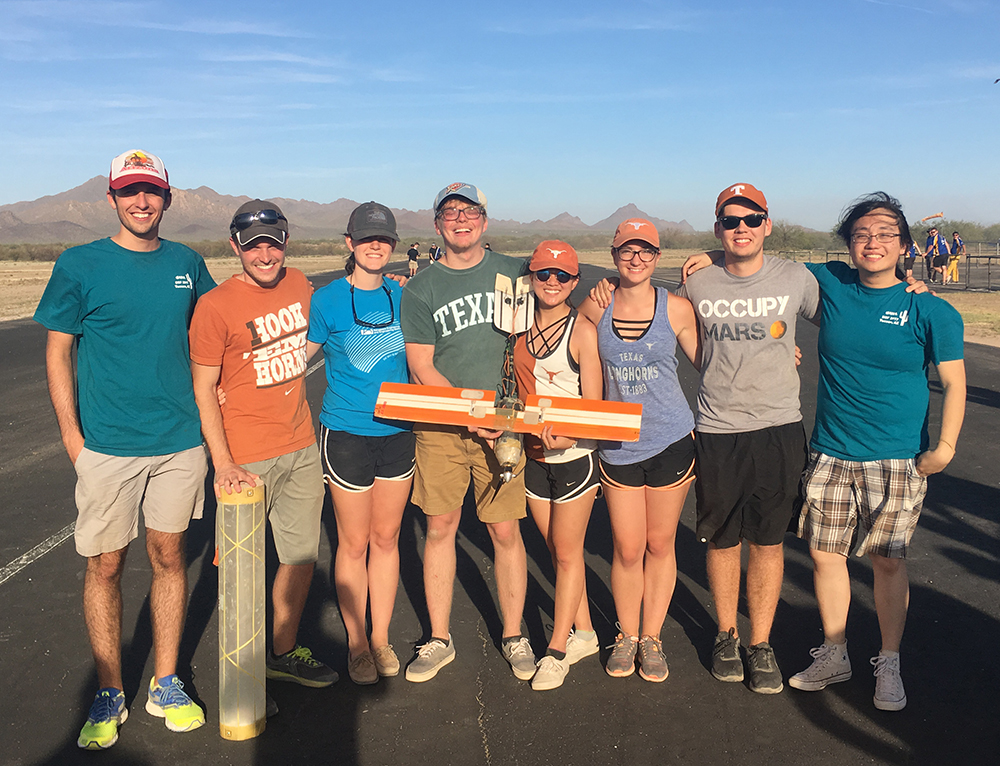
This April, the UT Austin Design/Build/Fly (DBF) team joined about seventy-five teams from around the world in Tucson, Arizona, for the annual international Design/Build/Fly competition hosted by the American Institute of Aeronautics and Astronautics and the Cessna Aircraft Company/Raytheon Missile Systems.
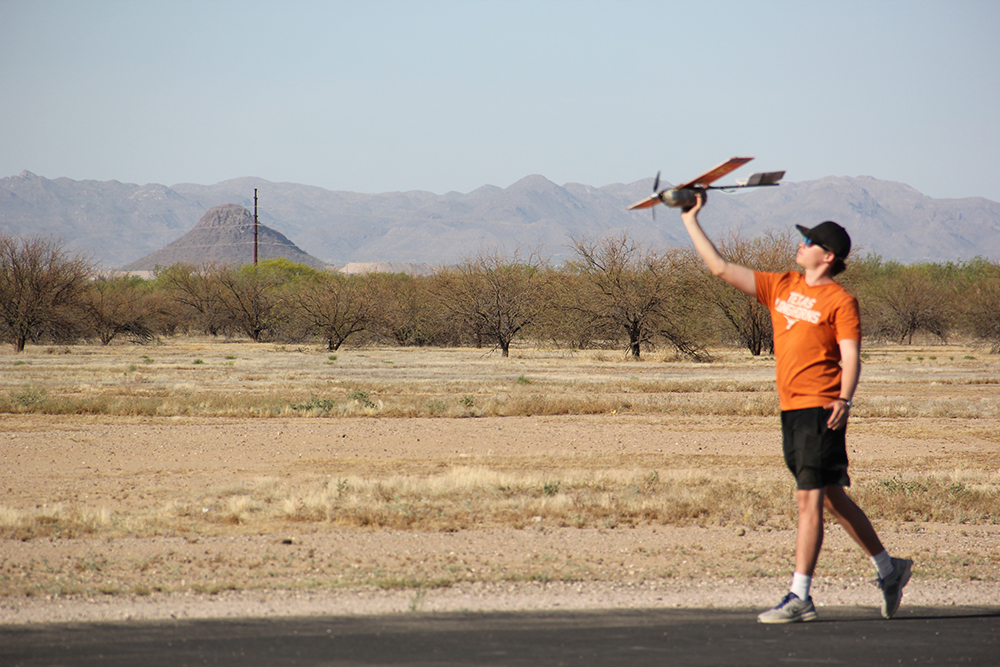
UT aerospace engineering undergraduate students spent the year designing and building an aircraft to complete a series of missions at the competition. Besides flying the aircraft, teams win points for the design report and size of the aircraft — the smaller the better. Though the team was not able to complete all the missions, they still managed to place ahead of other teams that did, due to the high score they received on the report and small size of the aircraft, which the team named Scout.
None
None
The Competition
The competition consisted of four missions. The first was to drop the airplane, folded up inside the tube, from three orientations, without the airplane breaking. The second was to fly the aircraft three laps within five minutes. The third required the airplane to carry three hockey pucks while flying three laps as fast as possible. And the last mission was to fly carrying any number of pucks chosen by the team.
The team did well on the first two missions but hit a snag on the third one. Scout could not take off with the hockey pucks. The aircraft was so light that the pucks more than doubled its weight. Because they did not complete the third mission, they could not go on to attempt the fourth one.
Ekiriwang said they were concerned about Scout’s ability to lift the weight beforehand but they had tested it out on the previous iteration so felt it would probably be fine.
“Even though we didn’t fly, we’re calling it a successful experience,” she said. “We completed mission one, and the ground mission successfully, which is not something all the teams can say.”
Valuable Experiences
Ekiriwang said the team learned a great deal from the obstacles they faced in the third mission. They managed to stay optimistic, even as they watched Scout fail to take off.
“That was a pretty good learning experience because we’re used to completing all the missions, and we’re used to doing pretty well,” she said. “It was really nice watching everyone stay positive and upbeat about it.”
Ekiriwang’s favorite part of the competition is the sense of camaraderie that the teams feel with each other. The competition also allows the different sub-teams, who work separately throughout the year, to get to know each other.
“Overall, everyone had a really good experience on the trip,” Ekiriwang said. “For me, that’s been a valuable experience throughout my time at college.”