
Wildfire Warriors
How UT Drone Swarms Could Revolutionize Firefighting
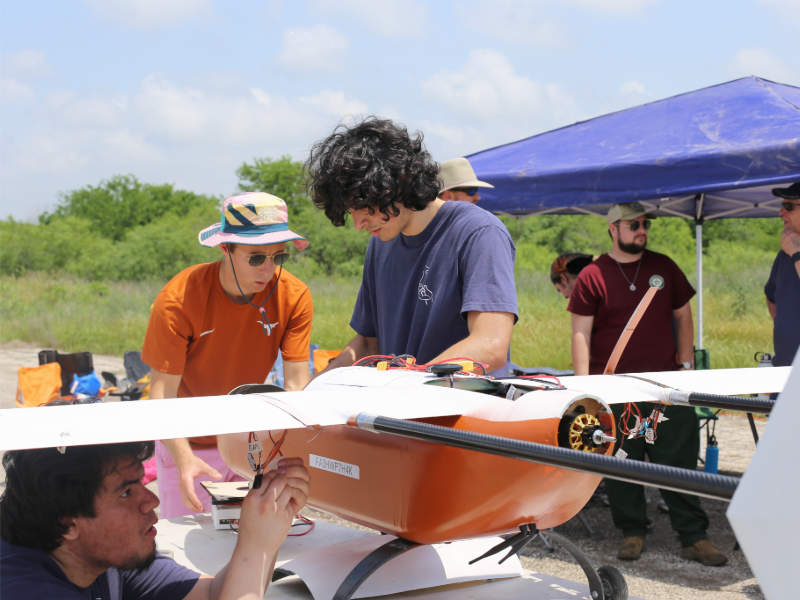
Wildfires are a growing global concern, endangering all forms of life on Earth through the physical threat of the fires themselves as well as their long-term impacts, like air pollution and ecosystem devastation. These extreme wildfires have become more frequent, more intense and larger in recent years. In response, the scientific community has answered the call to develop new technologies to battle these blazes before they become destructive.
The University of Texas at Austin is leading one of the last teams standing in a global competition called XPRIZE Wildfire. Researchers from the Cockrell School of Engineering and the Jackson School of Geosciences are teaming up with colleagues from the University of Southampton, University of Edinburgh and Texas A&M Forest Service to develop an autonomous fleet of drones that can rapidly detect and contain wildfires.
“Every minute counts when it comes to stopping the spread of a wildfire. Our drone fleet will make it easier to rapidly locate and contain dangerous wildfires.”
Luis Sentisprofessor in the Cockrell School’s Department of Aerospace Engineering and Engineering Mechanics
The Competition
This summer, team FLARE-X qualified as semifinalists to move on to the next stage of the XPRIZE Wildfire’s $5 million Autonomous Wildfire Response Track competition, part of the larger four-year, $11 million XPRIZE Wildfire contest. The UT team is one of only 15 teams out of over 100 initial competitors that remain eligible for the prize. The finals will happen next July, with the FLARE-X semifinals demonstration taking place this October.
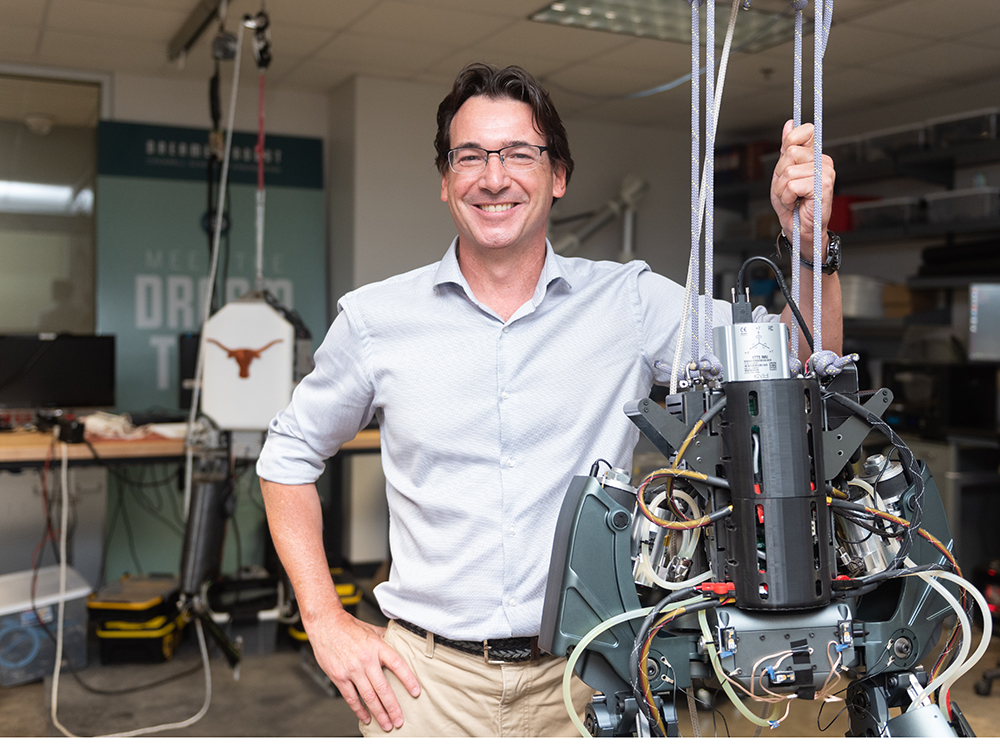

Luis Sentis (left) and Greg Zwernemann (right)
After several rounds of testing and validating their technology, teams will have just 10 minutes to detect and suppress a fire within a 1,000 km2 (386-square-mile) competition area somewhere in Alaska.
XPRIZE Wildfire is a four- year, $11 million competition incentivizing the innovation of firefighting technologies that will end destructive wildfires so that humanity and beneficial wildfires can safely co-exist. The prize aims to transform current wildfire management approaches through the development of new technologies that can rapidly and accurately detect, characterize and respond to wildfires before they become destructive.
The competition challenges teams to develop fully autonomous, integrated systems that can:
- Detect, assess and suppress an incipient-stage, high-risk wildfire
- Operate fully autonomously with no human intervention
- Do so in under 10 minutes, across a 1,000 km2 area
- Ignore low-risk fires — proving precision, not just speed
How it Works
The FLARE-X team will use several different types of UAVs to both detect and suppress fires. The team’s solution involves three main stages: dynamic pre-fire risk mapping; active fire detection, monitoring and verification; and fire suppression.
Scout UAVs outfitted with sensors containing state-of-the-art motion planning and data processing algorithms can cover large areas quickly to spot the fires and coordinate suppression efforts. Then, a group of striker UAVs flies to the correct position before releasing a swarm of smaller terminator drones that deliver fire suppressant bombs on their targets.
“A major issue that most current firefighters have is scale and accessibility. Our solution is to use many low-cost, unmanned, autonomous fixed-wing aircraft that drop fire retardant onto fires, both at a small/ incipient stage and to create fire breaks for larger fires. Other aircraft are too expensive to have on standby, whereas this new technology is critical to catching and extinguishing fires early before they cause too much damage.”
Andrew DotyIntegrated Project Team Lead, FLARE-X
The Team
The large team illustrates the complexity of the challenge. UT Austin’s ASE/EM department is leading the project through a partnership with the Jackson School of Geosciences.
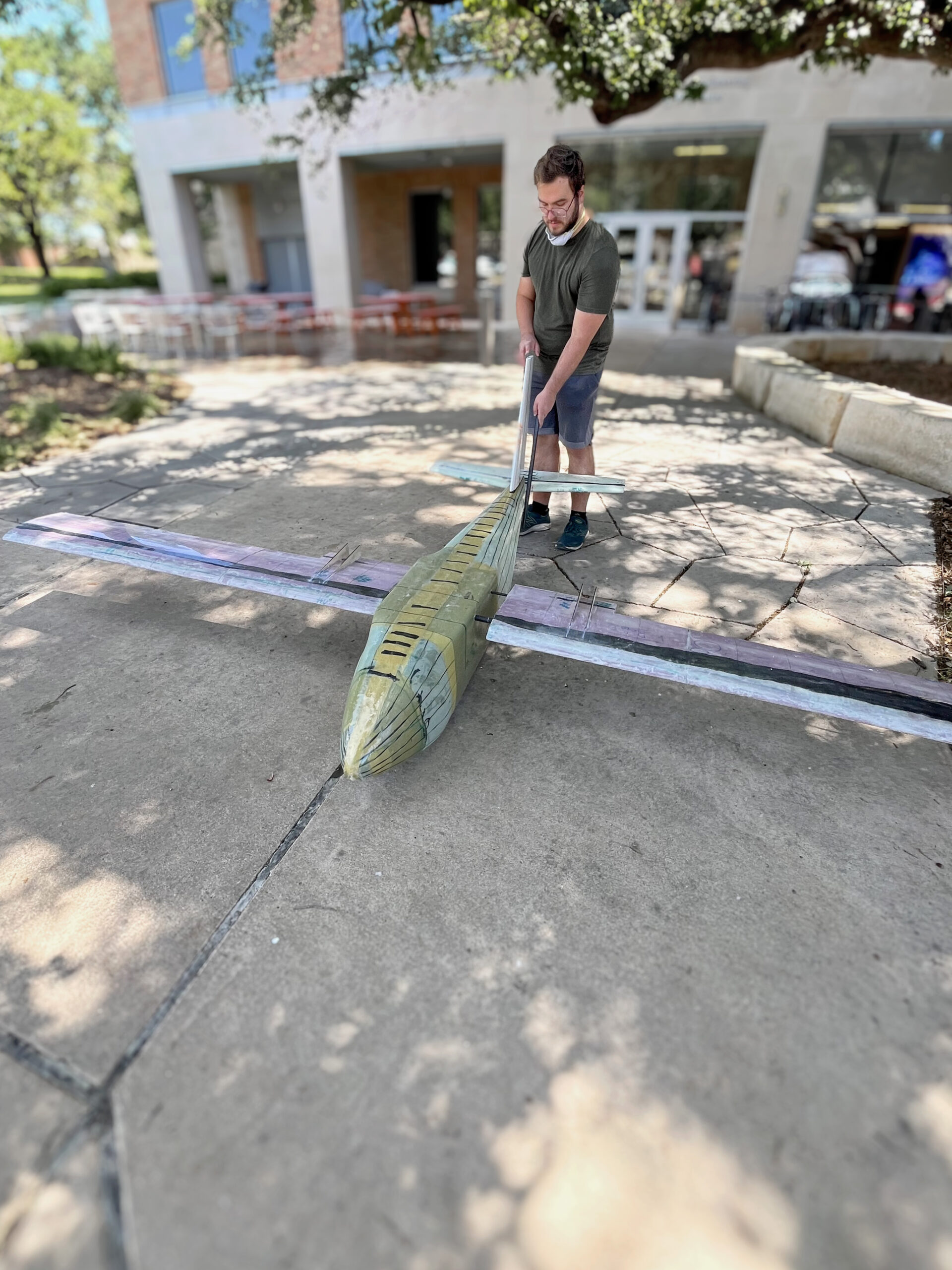
The ASE/EM team, which includes faculty members Luis Sentis, Jayant Sirohi and Greg Zwernemann, are developing two types of UAVs, fire suppression payloads and machine learningsoftware that provides system autonomy.
The Jackson School is developing advanced infrared sensors for fire detection and geolocation. The University of Southampton is developing key system software and hardware solutions; mission management software that enables autonomous control of a swarm of UAVs; and communications and datalink solutions.
The University of Edinburgh is developing advanced fire suppression technology. The Texas A&M Forest Service is advising the team on fire detection and suppression techniques.
Initial Testing
This past spring, a team of aerospace engineering seniors conducted the first demonstration of the FLARE-X wildfire detection and suppression mission concept of operations (ConOps) at the Texas A&M RELLIS test facility. The aircraft designs and ConOps were developed as part of the senior capstone design course.
The demonstration featured a simulated wildfire overflight search by the Tico prototype aircraft, equipped with a prototype of the UT-developed infrared sensor system, and delivery of a fire suppression drone by the Hugin concept development aircraft, which served as a surrogate for the payload delivery aircraft.
“This test provided us with important information on how to refine our ConOps and improve the design of our aircraft, leading up to the semifinals demonstration in October,” said Greg Zwernemann, professor of practice and instructor of the aerospace senior design course.
Even after graduating this spring, several of these former senior design students continued to refine their ConOps project over the summer months in preparation for the upcoming semifinals this fall.
What’s Next
In this next stage of the competition, teams move on to real-world field testing. Over the coming months, the XPRIZE Wildfire operations team will travel to each semifinalist team’s location for in-field testing. Teams will physically demonstrate their autonomous end-to-end wildfire response system, including smart detection, autonomous navigation and safety, and autonomous suppression, along with an overall technical readiness and scalability assessment of their system. These live trials will be captured by the testing partner, the Alaska Center for Unmanned Aircraft Systems Integration, and will be used for official judging, offering a unique behind-the-scenes look at wildfire technology in action.