
Akella Honored for Advancing Aerospace Engineering Through Controls and Autonomy
Maruthi Akella has been awarded the Joe J. King Professional Engineering Achievement Award for his contributions to aerospace engineering, particularly in guidance, navigation and control, autonomous robotics, and spaceflight systems.
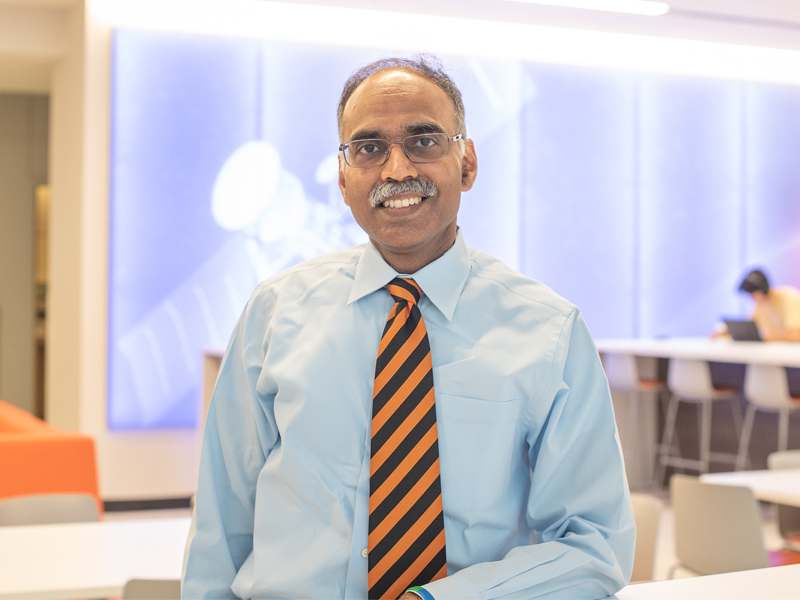
Maruthi Akella has been awarded the Joe J. King Professional Engineering Achievement Award for his contributions to aerospace engineering, particularly in guidance, navigation and control, autonomous robotics, and spaceflight systems.
Akella, professor and Cockrell Family Chair in Engineering #19 in the Department of Aerospace Engineering and Engineering Mechanics, has been a member of The University of Texas at Austin faculty since 1999. He leads the Controls Group for Distributed and Uncertain Systems and is affiliated with the Center for Space Research.
The Cockrell School of Engineering established the award in 1977 to recognize a faculty member who has made significant contributions to furthering the engineering profession. In the words of Joe J. King, a 1925 mechanical engineering graduate: “My feeling is that the recognition should encourage faculty members to demonstrate capabilities in broadly advancing the professional practice of engineering.”
Akella’s research focuses on controlling complex dynamical systems subject to nonlinearities and uncertainties, with applications ranging from autonomous spacecraft and robotics to cislunar astrodynamics and high-speed and hypersonic vehicles. His work brought many direct impacts for coordinated robotics and spacecraft proximity operations, including contributions from his research group to the onboard guidance algorithm for Intuitive Machines’ IM-1 mission, which achieved the first U.S. soft lunar landing in more than 50 years.
“Maruthi’s work exemplifies the kind of engineering impact this award was created to recognize,” said Clint Dawson, chair of the Department of Aerospace Engineering and Engineering Mechanics. “His research has advanced our understanding of guidance, control and autonomy while translating fundamental ideas into technologies that enable increasingly capable aerospace systems. Just as importantly, he has helped train generations of engineers and researchers who are carrying that work forward.”
Akella is Editor-in-Chief for The Journal of Astronautical Sciences and serves on the editorial boards for the Journal of Guidance, Control, and Dynamics and the IEEE Transactions on Aerospace and Electronic Systems. He has published more than 300 peer-reviewed research papers and has received numerous honors for his contributions to aerospace control and astrodynamics, including the AIAA Mechanics and Control of Flight Award, the American Astronautical Society’s Dirk Brouwer Award, the IEEE Control Systems Society Award for Technical Excellence in Aerospace Control, and the AIAA von Kármán Lecture in Astronautics Award. He is a Fellow of AIAA, IEEE and AAS and holds the Academician rank with the International Academy of Astronautics.
In 2024, the International Astronomical Union named asteroid 5376 “Maruthiakella” in recognition of Akella’s contributions to astrodynamics and the successful application of his research.