
From Origami to Orbit: New ASE/EM Faculty Member Jaden Suh Is Rethinking Space Structures
New ASE/EM faculty member Jaden Suh is rethinking how spacecraft can be designed to go bigger once they leave Earth, exploring origami-inspired structures, smart materials and in-space assembly.
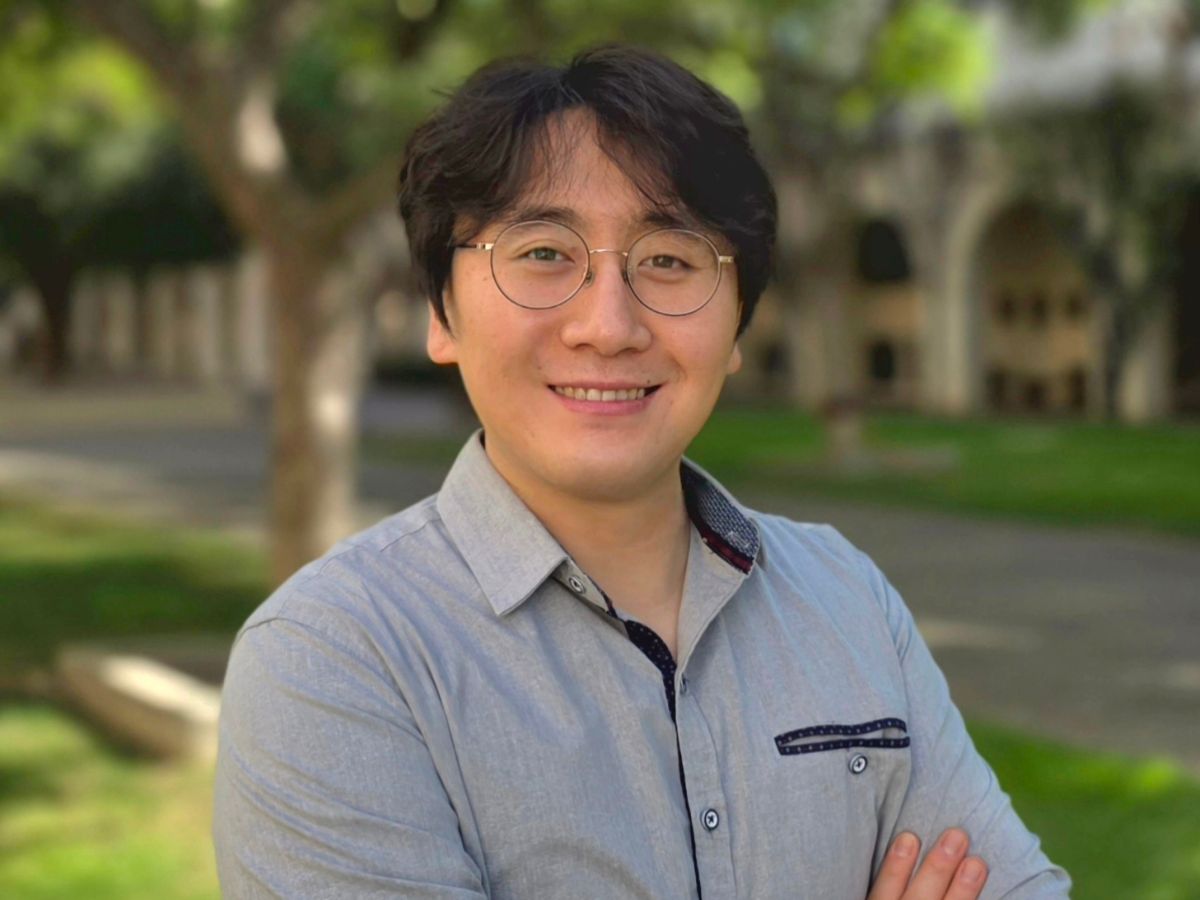
New ASE/EM faculty member Jaden Suh is exploring how spacecraft can be designed to go bigger once they leave Earth.
Suh joined The University of Texas at Austin’s Department of Aerospace Engineering and Engineering Mechanics as an assistant professor in August 2026. His research focuses on the mechanics, design and construction of large, lightweight and precise space structures, including structures that could be too large to launch as a single piece.
His work spans nonlinear mechanics, in-space assembly and manufacturing, origami-inspired deployable and reconfigurable structures, and intelligent and adaptive structures. At the center of his research is a fundamental challenge: How can engineers create structures that begin compact enough to launch but become much larger while remaining lightweight, precise and reliable?
“Everything we send to space has to fit inside a launch vehicle, while the structure we eventually want in orbit may need to be far larger,” Suh said.
That question has guided Suh’s research from graduate school at the Korea Advanced Institute of Science and Technology, or KAIST, to his postdoctoral work at Caltech.
Suh’s interest in space began with a childhood fascination with the unknown, but his research direction took shape at KAIST after his advisor introduced him to research in aerospace materials and structures, including large deployable structures and 3D printing in space.
Suh went on to study deployable structures during his master’s program and reconfigurable structures during his doctoral studies, developing origami-based tubular structures with tunable stiffness and stability.
Today, he combines origami-inspired designs, smart materials and in-space assembly to explore how large space structures can become more adaptable and capable.
Origami-inspired designs can create lightweight structures that undergo significant changes in shape or volume, while smart materials can allow structures to adjust their shape, stiffness or dynamic response. In-space assembly could allow engineers to launch individual components and build structures in orbit that are far larger than a launch vehicle could carry.
“These three areas may sound quite different from one another, but for me they are all approaches to the same broader question,” Suh said. “How can we create extremely large and precise space structures that can maintain their performance over long-duration missions?”
Such technologies could enable new approaches to large space telescopes, communications platforms, space-based power systems and other future space infrastructure.
Building those structures in orbit, however, presents its own challenges. A structure can pass through multiple configurations during assembly, each with different mechanical characteristics. Robotic systems interacting with the structure can also introduce vibrations, impact loads, geometric errors or structural instabilities.
“The structure, the robotic system and the assembly sequence cannot really be considered independently of one another,” Suh said. “Understanding how all three interact throughout the process is one of the areas I am most interested in.”
Suh has already experienced the transition from research concept to flight hardware. After earning his Ph.D. from KAIST in 2022, he joined Caltech’s Space Structures Laboratory as a postdoctoral scholar, where he studied in-space assembly through the Novel Orbital and Moon Manufacturing, Materials, and Mass-efficient Design (NOM4D) program. He developed an architecture for assembling tension truss reflectors using a stationary robotic facility.
He also designed and built a flight system to demonstrate autonomous structural assembly in orbit.
“A concept that looks elegant in a simulation suddenly has to survive launch, operate reliably, fit within very strict mass and volume constraints, and work together with many other subsystems,” Suh said. “Every interface, tolerance, fastener and test starts to matter.”
The flight system launched aboard SpaceX Transporter-16 in 2026, giving Suh the opportunity to see years of design, prototyping and testing culminate in a mission.
“I was there for the launch and watching the Falcon 9 lift off with something we had spent years developing onboard was a very emotional moment,” he said.
The experience reinforced Suh’s approach to research: connecting fundamental mechanics with real engineering systems.
“I enjoy working on fundamental ideas, but I also want to push them far enough to see what happens when they become real engineering systems,” he said.
That balance is one of the qualities Suh hopes to bring to UT Austin. He was drawn to ASE/EM’s broad research strengths and collaborative environment, as well as the hands-on engineering culture among students. He was particularly impressed by organizations such as the Texas Rocket Engineering Lab, Texas Spacecraft Laboratory and Longhorn Rocketry Association.
As a new faculty member, Suh hopes to build a research group where students can move from fundamental mechanics to real engineering systems by developing, fabricating and testing new structural concepts and eventually advancing them toward flight demonstrations.
“More than anything, I would like it to be a place where students can take an idea from an equation or a simple model all the way to something they can build, test and hopefully someday fly,” he said.
Ultimately, Suh hopes his research will help enable new kinds of space missions.
“The larger goal stays the same, which is to make the structure less of a limitation on what a space mission can accomplish,” Suh said. “Advances in structures could eventually let us consider entirely new kinds of missions that we cannot realistically imagine today.”