
Clements Receives Bradford W. Parkinson Award
Institute of Navigation honors UT Austin alumnus for research to detect and locate interference affecting satellite navigation signals
Satellite navigation signals are remarkably faint. By the time they reach Earth’s surface, they are about as faint as a 50-watt light bulb seen from 2,000 kilometers (about 1,240 miles) away.
That vulnerability is what Zachary Clements set out to address.
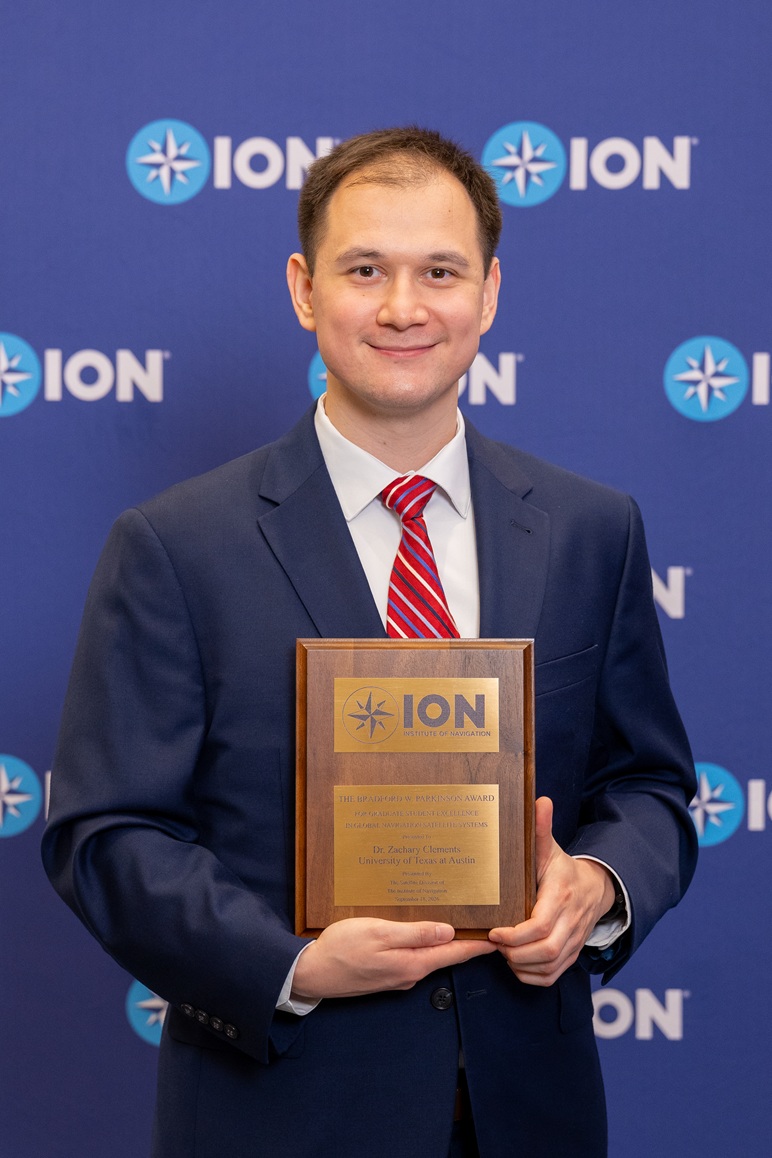
On Sept. 12, Clements, a graduate of The University of Texas at Austin’s Department of Aerospace Engineering and Engineering Mechanics, received the Bradford W. Parkinson Award from the Institute of Navigation. The award recognizes outstanding graduate research in global navigation satellite systems, or GNSS, and is named for Bradford Parkinson, the chief architect of the U.S. Global Positioning System.
Clements accepted the award at the Institute of Navigation’s ION GNSS+ conference, with Parkinson in the audience. The two also spoke at the event.
“It was an honor to receive this award; I could not have done it without the help of so many people,” Clements said. “It was a special moment to receive the award at the ION GNSS+ conference, surrounded by the many friends and colleagues I’ve made throughout this journey.”
For Clements, Parkinson’s presence made the recognition especially meaningful.
“It’s inspirational to see how involved he still is within the navigation community,” he said.
Clements’s research addressed a problem that reaches well beyond GPS: how to detect and locate interference that can disrupt satellite navigation signals. GNSS supports technologies used in autonomous systems, aviation, location-based services, environmental monitoring and critical infrastructure.
His dissertation, “GNSS Interference Detection and Geolocation,” developed algorithms to locate interference using data from single-satellite platforms, dual-satellite platforms and ground-based receiver networks.
“The goal of my dissertation was to develop capabilities to protect the GNSS spectrum from harmful interference,” Clements said.
During his doctoral studies at UT Austin, Clements and his research collaborators identified a Russian satellite constellation broadcasting GNSS interference over Europe. In May, the science YouTube channel Veritasium featured the final chapter of his dissertation. Other parts of his Ph.D. research on GNSS interference also drew coverage from outlets including The New York Times, Financial Times, NPR, WIRED and Ars Technica.
“During my Ph.D., I was able to investigate emerging challenges within the positioning, navigation and timing (PNT) community. I’m especially proud of the impact this research has had,” Clements said.
Clements completed his doctoral work in the Radionavigation Laboratory under Todd Humphreys, a UT Austin professor of aerospace engineering and engineering mechanics. His research was supported by the U.S. Department of Transportation and the Center for Automated Vehicle Research with Multimodal AssurEd Navigation, a Tier 1 University Transportation Center.
“The opportunity to work with Professor Todd Humphreys was the reason why I chose to pursue my Ph.D. at UT Austin,” Clements said. “This dissertation would not have been possible without his guidance and mentorship.”