
Luke Peterson Earns Air Force Young Investigator Award for Cislunar Research
The $450,000 award will support research building on UT Austin’s legacy in orbital mechanics to advance mission planning in the region between Earth and the moon.

Background artwork: From Motion Sensors, a series of silver gelatin prints by Rosalyn Farley (2025–26).
Luke Peterson, an assistant professor in the Department of Aerospace Engineering and Engineering Mechanics at The University of Texas at Austin, has received a Young Investigator Program award from the Air Force Office of Scientific Research (AFOSR) to advance the understanding of satellite motion in the region between Earth and the moon.
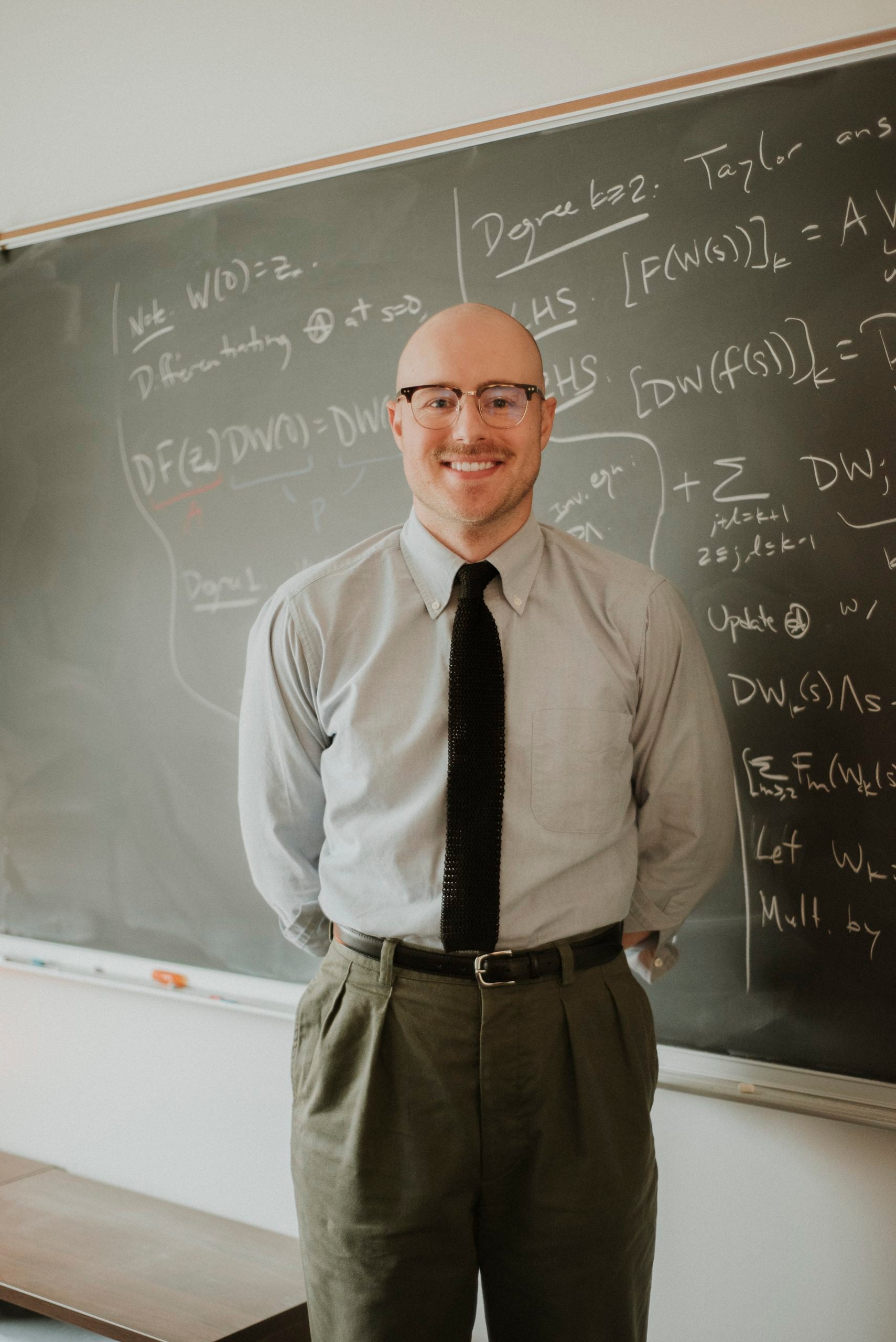
The three-year, $450,000 award will support Peterson’s research project, “Local Orbital Elements in Cislunar Space.” His work aims to develop new mathematical tools for understanding and predicting satellite motion in cislunar space, building on decades of advances in orbital mechanics, including foundational research by UT Austin faculty members.
“I hope to better understand the way a satellite moves around the Earth and the moon, relate this motion to our strong understanding of satellites’ orbits near Earth, and communicate this to operators to enable a new generation of space exploration,” Peterson said.
Building on UT Austin’s Legacy in Orbital Mechanics
Cislunar space encompasses the region around Earth and the moon, where the gravitational influence of both bodies shapes the motion of satellites and spacecraft. As government agencies and commercial organizations prepare for a new era of lunar exploration, understanding these dynamics will be increasingly important for designing and operating future missions.
Near Earth, engineers can use well-established mathematical models to describe satellite orbits. These models allow mission designers to represent an orbit using a set of parameters known as orbital elements, making it easier to predict a satellite’s motion and account for changes caused by other forces.
The foundation of this approach is the two-body problem, which describes the motion of two objects under their mutual gravitational influence. In this simplified model, a satellite’s orbit can be represented by a conic section, such as a circle or ellipse. These predictable mathematical solutions underpin many techniques used in satellite operations and mission design, including methods for planning interplanetary trajectories.
“Thanks to people like Kepler and Newton, we know the answer to this question: They move in conic sections (circle, ellipse, parabola, hyperbola),” Peterson said of the two-body problem. “Despite being a seemingly facile model, the dynamics of the two-body problem drive our ability to accomplish space missions because that system is explicitly solvable.”
In other words, engineers can calculate the orbit mathematically rather than relying solely on numerical simulations to track a spacecraft’s position and velocity over time.
In cislunar space, however, the gravitational interaction among Earth, the moon and a spacecraft creates a more complex environment. The circular restricted three-body problem (CR3BP) is a simplified mathematical model used to study these dynamics. Unlike the two-body problem, it does not have a general, explicit solution, and its dynamics can exhibit chaotic behavior.
Understanding this complexity has been a longstanding challenge in orbital mechanics. Even during the Apollo program, researchers recognized the importance of understanding multi-body dynamics for missions to the moon and for establishing a sustained presence in the region.
Former UT Austin faculty members Roger Broucke and Victor Szebehely were central to the study of special solutions of the CR3BP, including Lagrange points, periodic orbits and invariant manifolds. These mathematical structures help researchers understand the behavior of spacecraft in the Earth-moon system and inform the design of trajectories for space missions.
“The advancement of computational power, along with the persistence of Professors Kathleen Howell and Daniel Scheeres, NASA mission designers Dave Folta and Martin Lo, the Barcelona school (especially Carles Simó, Gerard Gómez, Josep Masdemont, and the late Àngel Jorba), and many others, led to a thorough understanding of special solutions to the Earth-moon CR3BP and how their shadows persist into the real solar system — not just an idealistic, simplified model,” Peterson said.
This body of work has helped researchers move beyond idealized mathematical models to understand how their solutions relate to spacecraft motion in the real solar system.
Connecting Classical Orbital Mechanics to Cislunar Space
Peterson’s research builds on this foundation. His framework, called local orbital elements, aims to connect the classical orbital mechanics used to understand satellites near Earth with modern approaches to the more complex dynamics of cislunar space.
Although researchers can use special solutions of the CR3BP to design individual spacecraft trajectories, managing many satellites in cislunar space presents additional challenges. Near Earth, orbital elements provide an intuitive way to describe satellite motion and predict how orbits change under the influence of additional forces, such as Earth’s oblateness and atmospheric drag.
Peterson sees an opportunity to develop a similar framework for cislunar space.
“One might hope that there would be similar sets of coordinates in the CR3BP, relating the state (position, velocity) of a satellite to the special solutions studied by researchers such as Roger Broucke, Victor Szebehely, Kathleen Howell and Daniel Scheeres,” he said. “That’s where our work comes in.”
The theory of local orbital elements uses special solutions of the CR3BP as reference points for describing spacecraft motion. Rather than treating the complex dynamics as one large problem, the approach aims to break them into smaller, more manageable mathematical problems.
“The theory of ‘local orbital elements’ is, I claim, the link from the classical theory of the two-body problem used in near-Earth and deep-space mission design to the modern theory of special solutions in the CR3BP and higher-fidelity models,” Peterson said.
By developing coordinates suited to the cislunar environment, Peterson hopes to adapt established techniques from classical orbital mechanics to help engineers analyze trajectories, predict satellite motion and design missions in this more complex setting.
The project will further develop the theory, apply it to practical engineering challenges and investigate how methods used in near-Earth and deep-space mission design can be adapted for cislunar missions.
Preparing for a New Era of Lunar Exploration
An estimated 100 or more missions to the moon and cislunar space are projected over the next 10 to 15 years.
As activity increases, mission designers will need effective ways to understand satellite motion, plan trajectories and manage spacecraft operating in this complex environment. More intuitive mathematical tools could help engineers apply decades of research to the growing demands of lunar exploration.
For Peterson, one of the most exciting aspects of the work is the opportunity to move between mathematical theory and real-world engineering needs.
“I am most excited by the back-and-forth between using theory to resolve a difficulty in an application and, vice versa, identifying gaps in the theory stemming from modern engineering requirements,” he said.
By bridging classical orbital mechanics and modern approaches to cislunar dynamics, Peterson hopes to make decades of advances in orbital research more accessible to engineers designing future missions.
Advancing Research and Growing the Next Generation of Expertise
The AFOSR Young Investigator Program supports early-career faculty conducting research with the potential to advance scientific and engineering capabilities relevant to the Air Force and Space Force.
For Peterson, the award marks an important milestone in building his research program.
“This is my first grant, so I am grateful to have the support of people in my community, of which I am a new member to some extent,” he said.
The funding will allow Peterson to hire a postdoctoral researcher to help develop and advance the project, expanding his research team as he works to translate theoretical advances into practical tools.
“I am excited to work with them, incorporate them into my group, and look at each other confusedly at the blackboard,” Peterson said.
Through the project, Peterson aims to establish a more intuitive framework for understanding orbital motion between Earth and the moon. Building on UT Austin’s history of contributions to orbital mechanics, his research could help equip mission designers with new tools to support the next generation of lunar exploration.