
Texas Engineer Joins Effort to Land New Space Academy
Lori Magruder will represent UT in a statewide push to bring the new Space Academy to Texas.
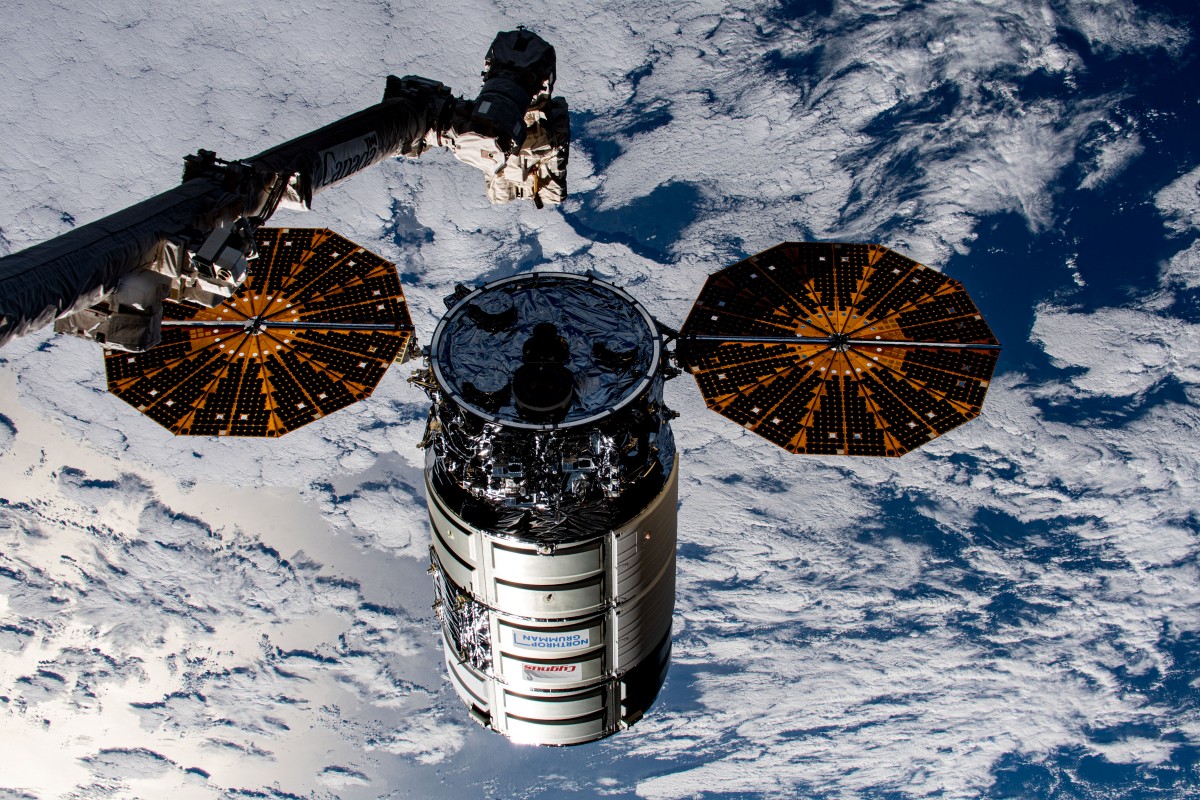
The Cygnus cargo spacecraft is pictured moments away from being captured by the Canadarm2 robotic arm.
Lori Magruder will play a key role in a statewide push to make Texas the national aerospace capital.
The aerospace engineering professor and director of the Center for Space Research at The University of Texas at Austin was recently tapped to serve on a leadership team tasked with bringing the new United States Space Academy to Texas. The academy, announced last month, will be led by NASA and serve as an additional outlet for training future generations of space professionals.

“I’m honored to join this team along with my colleagues from across the Texas aerospace ecosystem,” said Magruder. “Together, we can showcase all the many reasons Texas is at the center of this new era of workforce development to support the next generation of space technology, operations and policy.”
Joining Magruder on this team are:
- Nancy Currie-Gregg, director, Texas A&M Space Institute, retired Army Colonel and former NASA astronaut
- Heather Wilson, president, The University of Texas at El Paso and former U.S. Air Force secretary
- Evan Loomis, Texas Space Commission Board of Directors member
- Robert Ambrose, associate director, Texas A&M Space Institute
- Jack Fischer, senior Vice President, Intuitive Machines, retired Air Force colonel and former NASA astronaut
Magruder was selected in part because of her position on the Texas Aerospace Research and Space Economy Consortium (TARSEC) executive committee. She serves as the representative of the UT System on the committee, which brings together leaders in higher education and industry across Texas to drive the consortium’s interests.
Magruder is no stranger to large, ambitious space missions, having led the Science Team for NASA’s ICESat-2 mission for close to a decade. This major mission, launched in 2018, measures the elevation of ice sheets, glaciers, sea ice, tree canopy height, ocean height, and more to understand how the planet is changing over time.
Earlier this month, NASA published a Request for Information from states interested in becoming the home of the academy. An ambitious timeline is outlined in the request, calling for a groundbreaking no later than 2027, temporarily hosting the first 300 students in 2028, and a permanent location in operation by 2031.